

I Watched Two Strong People Decline And One Stay Strong (What I Saw Terrified Me)
The 3 Patterns That Separate Strength From Decline

You can stay powerful at any age when your surroundings keep demanding strength.
You’re not getting weaker because you’re getting older. You’re getting weaker because your environment has stopped asking you to be strong.
Your home isn’t neutral. It’s either a strength coach or a hospice. And most people are living in the latter without realizing it.
In the next sections, I’ll share easy strategies to make your environment a strength coach. This way, you can regain strength at any stage of life.
What looks like convenience is teaching your muscles that they are no longer needed.
I know because I watched it happen twice. And I almost let it happen to me.
The Moment I Saw It In Myself
On Tuesday morning, I almost asked my wife to grab my coffee, which was three feet away on the counter.
The words were already forming in my mouth.
On Thursday evening, I was deep into a soccer match when I realized my book was on the shelf across the room. “Hey, son, can you grab that book for me?” He brought it without hesitation. Then I asked for juice. And a glass.
He didn’t question it.
I was unwinding after a long day.
On Saturday, I was at McDonald’s. I watched my order process at the self-service machine. Payment confirmed. Then the final screen appeared: “Collect at the counter or deliver to the table?”
My finger hovered over “deliver to the table.”
That’s when I froze.
Right there, at that McDonald’s, I made a rule: If I can reach it in under a minute, I walk to it myself. No exceptions. No negotiations. That one rule has saved me from a thousand small surrenders since.
I also started a few other micro-rules that became protectors of strength in my daily life.
Another rule I adopted: If I can carry it with one hand, I don’t use a cart or trolley. These small, intentional actions keep me engaged and active throughout the day.
Because I finally saw what I’d been doing.
Three feet to the counter on Tuesday. Twenty feet to the bookshelf on Thursday. Thirty feet to the McDonald’s counter on Saturday. These are small distances. Tiny efforts. All outsourced. All is accepted as normal.
I am 42 years old.
And I was negotiating with my body over distances my grandfather walked without thinking.
The terror wasn’t dramatic.
It was ordinary.
Right now, you might be thinking: “But I’m just busy. I’m not declining; I’m efficient.”
That’s what I told myself too.
“I’m not lazy; I’m optimizing my time.” “My son is already up. Why not ask him to grab the book?” “McDonald’s offers table delivery that’s progress, not a weakness.” I had a reason for every convenience I accepted.
And every reason sounded logical until I saw where they led.
Marcus had reasons too. “My hip hurts; I should rest it.” My father had reasons. “I worked 43 years; I’ve earned this.” The 80-year-old probably has reasons to accept help. Her back aches. Her knees are 80 years old. Her family begs her to take it easy.
She refuses anyway.
She understands something we’re just starting to grasp:
Your reasons for choosing convenience are the same reasons your body wants to quit.
A thousand small surrenders I didn’t notice until the damage was done.
My father suffered a severe stroke three years after his retirement. Marcus sat in a swing chair for six months. His body grew weaker, and standing became impossible. Both are strong men. Both declined fast.
And I was walking the same path, one convenience at a time.
What I Saw That Explained Everything
After my father’s stroke, everyone said, “He’s getting older.”
But three years before, he was strong. He’d worked 43 years. When he retired, he felt exhausted and needed rest. We thought the same. So we made life easier for him.
Everything was within reach in his bedroom.
We drove him places. Carried things for him. We removed effort wherever we could.
Within three years, a stroke left him paralyzed.
I couldn’t accept “aging” as the answer.
So I looked deeper into his environment and the design of his daily life.
Then I saw Marcus.
Forty-nine years as a farmer. Every morning before sunrise, checking fences, feeding livestock, hauling water, mending what broke. At 72, he fell. His hip never healed as it should have.
Carrying feed bags hurt.
Walking the property took twice as long.
So his kids convinced him to sell his farm. Move to the city. Rest. They set him up in a nice apartment. Swing chair by the window.
He sat in that chair and watched the street below.
No fences. No animals. No reason to stand.
Within six months, he couldn’t walk without help.
Everyone blamed the fall.
But the fall hurt his hip. Losing his daily work on the farm destroyed his body.
Then I met someone who shattered the pattern completely.
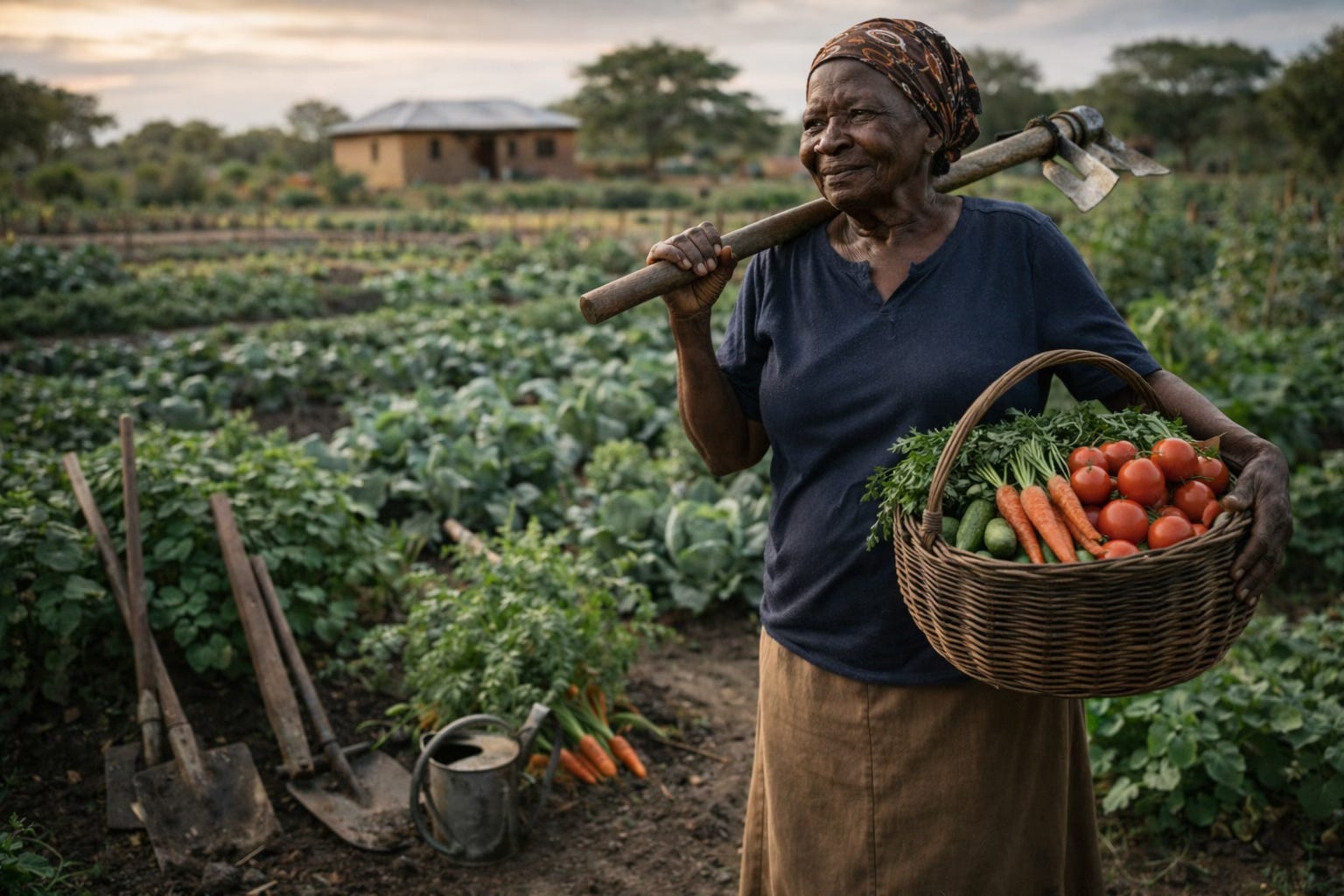
She’s 80 and my friend’s mother.
I met her on the road one morning. Walking back from her garden. Tools over one shoulder. A basket of vegetables on her hip. I offered to carry the basket.
She handed it to me, still walking.
“You do this every day?” I asked.
“The vegetables don’t grow themselves.” She responded.
Her husband died twenty years ago. She started the garden for income. Now, customers depend on her.
“Your family doesn’t help?”
She laughed.
“Help with what? My legs work fine.”
Every morning, the same 500-meter walk. Bending. Lifting. Carrying. Then to the market to sell. No car. No shortcuts. No one is doing it for her.
At 80, her hands are steadier.
Her stride is unbroken.
She is stronger than my father at 65. Stronger than Marcus at 72, before his fall. Same generation. Different outcomes.
I became obsessed with understanding why.
Here are three patterns that explain everything.
Pattern 1: Obligation Creates Structure
You’ve removed every obligation, thinking it is freedom.
It was the architecture holding your body upright.
The 80-year-old doesn’t garden because she loves vegetables. She gardens because they don’t grow themselves. Because customers depend on her. This isn’t motivation. It’s an obligation that exists outside her feelings.
My father had no obligations after retirement; Marcus had none after selling the farm.
Their families removed obligations to help them rest.
But rest without structure becomes stillness. And stillness becomes shutdown.
Exercise builds strength.
Obligation preserves it.
When you remove obligations, you’re not giving rest. You’re enabling quitting.
But not all obligations protect you.
Marcus carried 50-pound feed bags alone at 72 until his body broke. That was an obligation as punishment. My father went from 43 years of depletion to zero demand. His body got two messages: “Break yourself,” then “You’re no longer needed.”
The 80-year-old lives in the middle.
Her daily walk isn’t extreme. It’s consistent. The vegetables need her, but they don’t break her.
The right obligation creates a structure that builds you. Wrong obligation creates rigidity that destroys you.
The difference isn’t effort. It’s whether the demand preserves capacity or exceeds it.
Exercise is a choice.
Choices fade when life gets hard.
Obligation removes the debate.
Her body stays strong because something real depends on her. Not occasionally. Every single day. Something beyond her body pulls her forward.
But obligation alone doesn’t explain why Marcus collapsed in six months while my father took three years.
Both lost their structure, but one declined five times faster.
Pattern 2: Load Determines Adaptation
The woman carries tools daily.
Not because it’s optimal exercise. Because that’s what her life demands.
Here’s the law:
The body changes to what it carries. Life shapes you by the weight you accept.
And zero weight is still weight. It just trains in the opposite direction.
Heavy load builds capacity.
The right load builds resilience.
No load builds decline.
Marcus’s body adapted to 50-pound feed bags for decades. When the bags disappeared, his body didn’t plateau. It regressed to match the new load. Zero.
My father’s environment demanded nothing.
So his body provided nothing.
We carried things for him. Drove him everywhere. Removed every physical challenge. We thought we were protecting him. We were teaching his body that strength was a waste.
Your muscles aren’t decorative.
They’re responsive.
When your environment removes the load, your body reads one signal: no longer needed. Within months, it adapts downward.
But here’s what broke my brain: my father tried exercise after his stroke, Marcus tried physical therapy after his fall—both had access to load again, yet neither lasted three weeks.
The load alone wasn’t enough.
That’s when the third pattern revealed itself.
Pattern 3: The Reason Must Come First
The 80-year-old doesn’t walk to be healthy.
She walks because the market is 500 meters away and she has vegetables to sell.
My father tried exercising; Marcus tried physical therapy. Both failed. Not because they lacked discipline.
Because movement without reason is a hobby, and hobbies die when they feel hard.
The woman’s walk isn’t hard.
It’s necessary.
That distinction is everything.
Fitness advice says: add movement to your life. But movement dies when it’s optional. When your walk depends on motivation, you negotiate every day. Tired? Skip it. Cold? Tomorrow. Busy? Next week.
When your walk is required for something that matters beyond your body, negotiation ends.
Someone has to grow the vegetables and sell them. Someone must check the fence, feed the animals, and mend what is broken.
The reason pulls you forward.
Willpower is the engine only when there’s no reason.
And willpower runs out.
My father’s treadmill gathered dust within three weeks. Marcus stopped therapy after the fifth session. Same excuse both times: “I’m too tired.” They weren’t tired. Nothing meaningful was at stake.
Because the treadmill didn’t need them, and the therapy didn’t matter to anyone.
The woman’s vegetables would rot without her.
That’s not motivation; it’s a consequence beyond her body.
Here’s what saves you: Find something that fails if you don’t show up. Not something you should do. Something that breaks without you.
If your life doesn’t naturally demand movement, create a reason: Walk a neighbor’s dog, volunteer somewhere your absence is noticed, or tend a community garden can bring new energy and purpose to your life.
The difference between movement that lasts and movement that dies in three weeks isn’t discipline.
It’s whether something real depends on it.
What Terrified Me Most
It wasn’t what happened to them.
It was seeing their patterns living inside me.
Nothing stopped me from moving except for my choice not to. I was accepting conveniences without seeing the costs.
My father made a full recovery after months of rehabilitation.
He walks now. He travels. But I watch him slipping back into old patterns.
Everything is within reach again. Accepting help. Choosing comfort. The environment that almost killed him is rebuilding itself.
Seeing the pattern isn’t enough. You have to refuse it.
And refusal feels wrong when you’ve earned the rest.
What I Started Refusing
I stood up at McDonald’s.
Walked to the counter. Carried my own tray back.
It sounds absurd. A heroic act over a tray? That small “no” was the first step in rebuilding what I had quietly torn down.
Now, I walk to get my coffee.
Get my own book. Carry my own juice. Not because I love effort. Because I finally understood what eliminating it costs.
My wife thought I was being stubborn.
“Why are you making things harder?”
I wasn’t making things harder; I was refusing to make them easier.
Because “easier” was the language my father’s environment spoke. And within three years, his body forgot how to answer back.
What Comes Next
The three patterns explain what separates strength from decline.
But recognition isn’t protection.
You can see every pattern clearly and still inherit the decline. Knowing what’s happening doesn’t stop you from accepting the convenience.
Part 2 is about the refusals.
The four specific boundaries I built after watching two strong men fade and one woman remain unbreakable. These small boundaries keep me engaged in daily tasks. They break the cycle of convenience before it leads to dependency.
The choices that looked like punishment but functioned as preservation.
The small surrenders I stopped making before they piled up into a body that couldn’t remember how to be strong. Not theory. The exact refusals that kept my father’s decline from becoming my inheritance.
Because once you see these patterns in your own life, you have two choices:
Refuse them now, while refusal still feels optional.
Or accept them without hesitation until refusal becomes impossible.
Your home is either a strength coach or a hospice.
Count the distances you’ve eliminated this week. That number tells you which one you’re living in. Take a simple step to regain your strength.
I challenge you to walk one forgotten distance tonight. It could be a walk to the store, a stroll through your neighborhood, or simply opting for the stairs. Once done, reflect on how it felt and share your experience with someone. This small action might just start a chain of empowering decisions.

P.S. — Part 2 drops next week: The Four Refusals That Prevent Inherited Decline. Subscribe to receive it.
P.P.S. — What small convenience did you accept this week? What effort did someone remove “to help you”? I invite you to reply and share your stories or challenges with me. Your experiences can inspire others on their journeys. This helps build a community of resilience and strength. Sometimes, seeing your own pattern is what makes refusing it possible.
P.P.P.S. — Know someone who’s been “making things easier” for a parent? Someone who thinks rest is the reward after decades of hard work? Forward this. The patterns are invisible until someone names them. And by then, sometimes it’s too late.
Beautiful and powerful reflection, Jimmy. Thank you for naming what so many of us quietly feel but rarely say. Strength doesn’t just fade, it’s trained out of us by comfort, and we can also train it back through small, honest choices. This was a gentle wake-up call in the best way.
What frightened me most wasn’t the decline itself, but how quietly it was trained through comfort. Strength doesn’t disappear with age, it disappears when life stops asking for it.. powerful writing..