


For a decade, I built one half of a future and called it the whole thing.
Every spare dollar had a destination. Savings account. Retirement fund. Emergency buffer.
I knew exactly how much I would need at 75, what it would cost to live well, and how many months I had to get there.
What those spreadsheets couldn’t reveal was whether I’d still control my body as I reached 75.
Financial security is not a small thing. It is necessary and real. I had created a full plan, a clear picture of my future. Yet, I never really examined whether I could live that future.
A comfortable waiting room is still a waiting room.
The clean answer and the honest one
Clara said it over lunch.
She is a colleague, 64, someone who has navigated enough of life to answer most questions before they are fully asked. We were talking about aging, the way people do when they are close enough to it to feel its presence but still far enough to speak without urgency.
I asked her: when she thought about her independence 20 years from now, what was the one thing she most didn’t want?
She put down her fork. “I would never want to be a burden to my children.”
Clean. Certain. The fork went back up.
Paula told me something different. I walked with her one morning. She has walked this route so long that it no longer requires thought.
Side by side, moving, the way conversation opens up when you are not facing each other. I asked her the same question.
She didn’t answer immediately.
She kept walking, eyes fixed somewhere ahead on the road. Her words came slowly, circling, reaching for something she hadn’t let herself face yet.
She talked about not knowing what independence would even mean at 81. About whether she would still recognize herself. About the distance between now and everything she hadn’t yet done about it.
Most people would hear Clara’s answer and call it strength. They would hear Paula’s and call it uncertainty.
But those two answers are not measuring two different levels of readiness. They are revealing two different relationships with the same gap.
Clara knows what she wants. Paula is feeling the distance between wanting it and building it. One is sitting with the wish. The other is sitting with what the wish actually costs.
If you have ever felt a catch in your chest when answering a question like that, you already know which answer is more truthful. That discomfort is not confusion. It is the first honest moment.
And it is exactly where change becomes possible.
When the wish travels too far from the work
Not long ago, a younger man said something I have not been able to shake since.
No introduction needed. Just a man who should still feel strong, speaking about himself in a voice that had already given up on the distance between now and then.
“I would rather not reach the point of becoming a burden,” he told me. “I would rather die still strong than lose everything and need to be carried.”
The words arrived without hesitation.
That isn’t about strength, dignity or philosophy. It is what the gap sounds like after years of looking away from it.
The wish of “I never want to be a burden” has traveled a long distance to become “I would rather not exist than face what I have let happen.”
Between those two sentences lives an entire unaddressed life.
If any part of you recognizes that journey, this is not a judgment. But it is worth sitting with. Because the distance between his wish and yours may be smaller than the certainty in Clara’s answer made it feel.
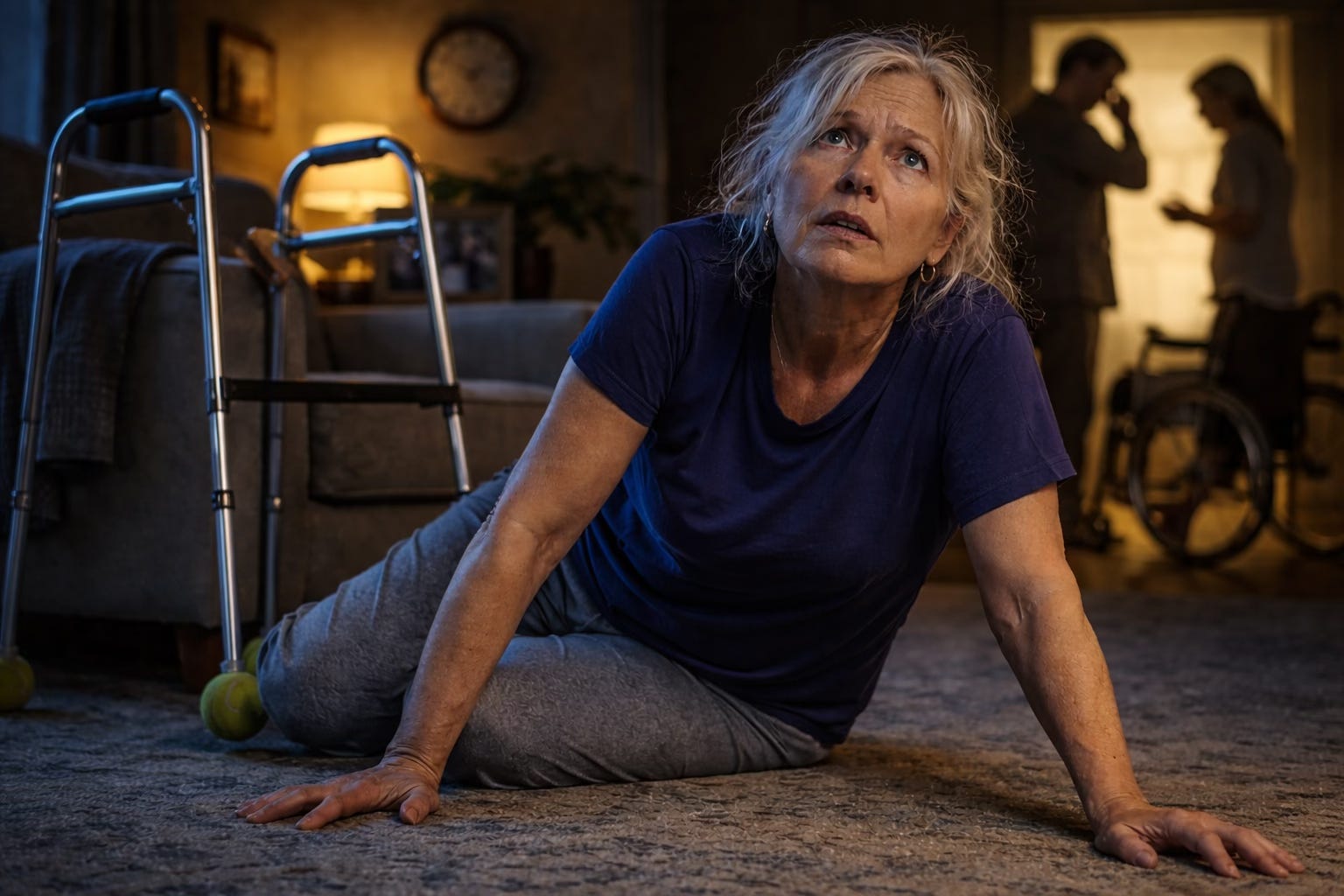
Now, let’s name the fear behind these answers.
Here is what those three conversations, and the decade I spent building only half a future, made impossible to ignore.
The fear of becoming a burden is not a fitness problem.
It is love with nowhere to go.
It is like a letter you wrote to someone you love and never sent. The words were true. The feeling was real. But they never received it.
You are carrying it right now.
Love for your children, your partner, the people who would one day have to reorganize their lives around your limitations. That love is real. It is among the strongest things you carry.
But love without the physical practice of staying capable remains a wish.
It produces guilt, not strength. It produces a clean answer at lunch that sounds like a plan but hasn’t been stress-tested against a single flight of stairs.
The people who remain independent into their 80s are not the ones who wanted it most.
They are the ones who understood that showing up, to move, to rebuild, to protect what time is quietly trying to take, is the act of love. Not a future act. A present one.
Today’s session is not about aesthetics.
It is not about discipline or proving something. It is the physical form of the wish you already carry. It is care made concrete.
Not “I have to do this.” But “I am doing this for them.” Quietly. Without announcement. The way love usually works when it is real.
The question that replaces every excuse
So before this week moves any further, one honest question.
Not about your program or your numbers.
Can you get up from the floor without using your hands? Carry something heavy up a flight of stairs without stopping? Walk for an hour without pain, deciding where you stop?
If yes, you are holding something worth protecting today, not eventually.
If not, that is not a verdict on who you are.
It is precisely where rebuilding begins. Discomfort that is faced honestly has always been the only place where capacity is built.
It is the first honest moment. And the first honest moment is always enough to begin.
You are not training to avoid becoming a burden.
You are training because the people you love deserve a version of you who chose to stay capable. Not someday. Today. And again tomorrow.
That is what love looks like when it stops being a wish and becomes a practice.

P.S. — If this piece shifted something in you, that is not an accident. It means you were already carrying the question and just needed someone to name it. There are more of these letters, every week, free. Subscribe so the next one finds you.
P.P.S. — Reply and tell me which conversation landed hardest. Clara, Paula, the younger man, or the decade I spent building only half a future. Your answer will shape what I write next. And if someone in your life is quietly living inside that gap, send this to them. Not as advice. As a company.
I try to keep it simple when I describe my future.
I’ll do what it takes to protect my brain, so I’m in control and not a burden to my children. Daily movement, hydration, nutrition, sleep, and connection. 🍏